

$108/T Global Tomato Price – Is It Time to Buy or Wait?
Global processing tomato raw material prices have declined for the third consecutive year. The global average price is projected to fall to $108/ton in 2026, indicating the market is entering a new period of stability.
Latest data from AMITOM and WPTC show that the global average reference price for processing tomato raw materials is expected to be $108/ton in 2026, a 5.2% decrease year-on-year, marking the third consecutive year of decline. However, the magnitude of the price adjustment has narrowed significantly, suggesting the global market may be nearing the bottom of this cycle.
I. Three Consecutive Years of Price Decline, But Still Above Historical Average
After experiencing historic highs in 2023, the global processed tomato raw material market has entered a period of adjustment.
According to the latest statistics from AMITOM and WPTC:
The weighted average reference price for global processed tomato raw materials in 2026 is projected to be $108/ton, a decrease of approximately 5.7% from $114/ton in 2025.
Although declining for the third consecutive year, current prices are still significantly higher than the pre-pandemic level of $70-80/ton.
More noteworthy are:
· Prices fell by approximately $13/ton from their peak in 2024;
· The decline is only about $6/ton in 2025-2026;
· The rate of decline has slowed significantly.
This indicates that the global processed tomato market has gradually recovered from the extreme conditions of 2023, and prices are currently seeking a new equilibrium range.
II. Global Price Trends Over the Past Two Decades
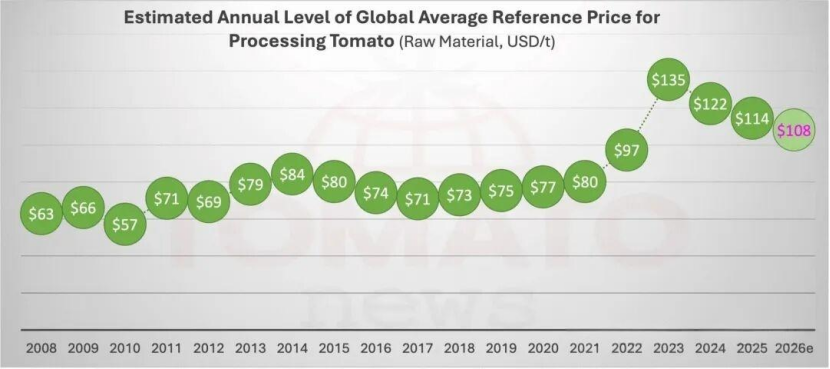
Figure 1: Changes in the Average Reference Price of Global Processed Tomato Raw Materials (USD/ton), 2008-2026
The figure clearly shows:
First Stage (2008-2021): Global prices remained relatively stable between $60 and $80/ton, with minor fluctuations.
Second Stage (2022-2023): Global prices rose rapidly due to factors such as extreme weather, the pandemic crisis, reduced production in Europe, and tight supply.
• 2022: $97/ton
• 2023: $135/ton (historical high)
Third Stage (2024-2026): With global expansion of planting, increased inventory, and a return to supply-demand balance, prices declined for three consecutive years:
• 2024: $122/ton
• 2025: $114/ton
• 2026: $108/ton (projected)
Overall, prices have gradually returned to a more reasonable and stable range.
III. Price Patterns in Europe, the United States, and China Remain Unchanged
To date, this statistic covers approximately 30 million tons of processed tomatoes, representing nearly 70% of the estimated global processing volume, and encompasses major tomato paste supply regions worldwide.
The statistic includes:
· United States (California)
· China
· Italy
· Spain
· Portugal
· Greece
· France
· Turkey
· Argentina
IV. Price Comparison of the Three Major Global Production Regions
Figure 2: Price Changes of Processed Tomato Raw Materials in Europe, California (USA), and China, 2008-2026
The trend chart shows that the three major global production regions have maintained a relatively stable price gradient over the long term.
Europe (EU5)
Estimated price in 2026: approximately US$123/ton.
Although declining for three consecutive years, it remains the region with the highest raw material prices globally. High labor costs, stringent environmental standards, and high production costs determine that European prices remain high in the long term.
California (USA)
Estimated price in 2026: approximately US$115/ton.
A significant decrease compared to US$152/ton in 2023, but still higher than the historical average.
In recent years, California has gradually restored prices to a more rational level through measures such as controlling planting area and optimizing contract farming.
China
Approximately US$70/ton in 2026.
China is the **only major processing country to see a year-on-year price increase (approximately 7%)**.
While this is an increase from US$65/ton in 2025, it remains significantly lower than major producing regions in Europe and the United States.
China continues to maintain its most competitive raw material cost advantage globally.
V. Global Raw Material Value Exceeds US$4.2 Billion
Based on projected processing volumes and raw material prices in 2026:
The total value of global processed tomato raw materials is estimated at approximately
US$4.2-4.4 billion
(approximately €3.6-3.8 billion).
This means that even if prices decline, processed tomatoes will remain a significant agricultural industry globally, valued at over US$4 billion.
VI. Has the Market Bottomed Out?
Based on the latest data, several positive signals are worth noting:
✅ Global average prices have been adjusting for three consecutive years;
✅ The annual decline has narrowed significantly;
✅ Prices in Europe and the US are gradually returning to reasonable levels;
✅ Global supply and demand are trending towards balance.
If the following do not occur later:
· Widespread extreme weather;
· A sharp rise in international energy prices;
· Geopolitical factors leading to a sharp increase in logistics costs;
It is expected that global processed tomato raw material prices will enter a relatively stable operating range of around $100-110/ton in the next few years.
This means that the industry is expected to end the recent boom-and-bust cycle and enter a new phase with more stable prices and a more balanced supply and demand.
Industry Observation (Xinjiang Tomato Products Industry Association)
① The global market has largely completed its adjustment after the high-price cycle.
After reaching a historical high in 2023, three consecutive years of price declines have gradually brought the market back to rationality, and by 2026, it was approaching a new equilibrium level.
② China's cost advantage remains significant.
Although raw material prices rose by approximately 7% year-on-year in 2026, the level of approximately $70/ton is still only about 57% of that in Europe and about 61% of that in California, USA, maintaining strong competitiveness in the international market.
③ The international price system is stabilizing, which is conducive to the long-term development of the industry.
Narrowing price fluctuations help growers, processing enterprises, and international buyers formulate more stable production and procurement plans, and also help the global tomato products trade return to a healthier development track.
